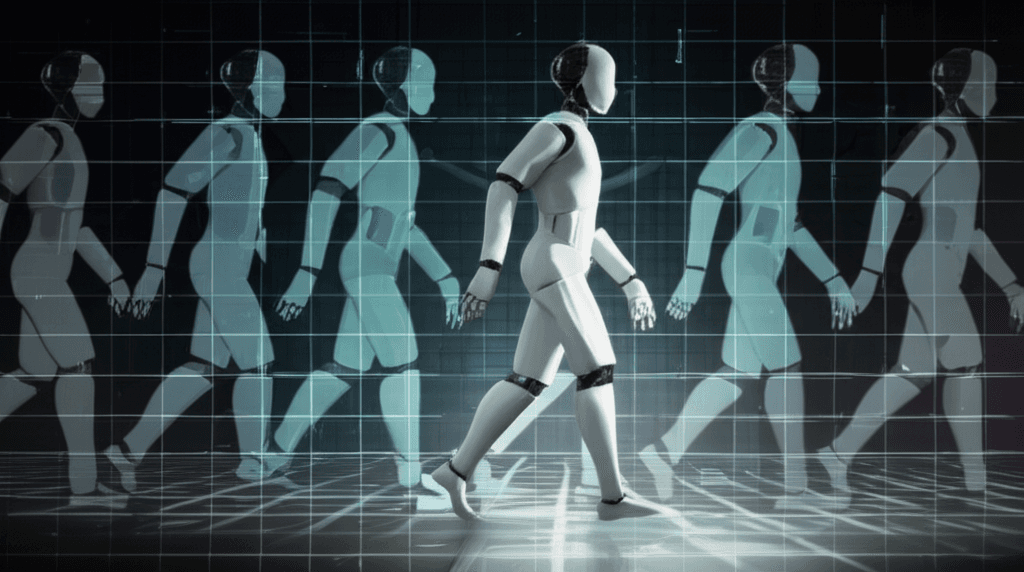
Generative AI for Robot Design: How Algorithms Are Inventing New Machines
For decades, robots have been designed by human engineers drawing on intuition, experience, and established mechanical principles. The result is that most robots look like things we already know: arms, legs, wheels, grippers. But what if we let AI design robots from scratch, with no preconceptions about what a robot should look like? The results are strange, surprising, and often better than anything a human would have imagined.
The Problem with Human-Designed Robots
Human designers are constrained by cognitive biases. We default to familiar forms. Industrial robot arms look like human arms. Mobile robots look like cars or animals. This is not because these are optimal designs — it is because they are the designs we can most easily reason about.
Nature figured this out through evolution. The mantis shrimp's club-shaped appendage delivers the fastest punch in the animal kingdom. The basilisk lizard's foot shape lets it run on water. These designs are counterintuitive, and no human engineer would have proposed them from first principles. They emerged from millions of years of optimization by natural selection.
Generative AI brings a similar optimization capability to robot design, but compressed into hours or days instead of millennia.
Approaches to Generative Robot Design
Topology Optimization
Originally developed for structural engineering, topology optimization starts with a block of material and iteratively removes material that is not contributing to the design goals. The result is organic-looking structures that are lightweight yet strong.
In robotics, topology optimization is used for:
- Robot chassis design — minimizing weight while maintaining stiffness
- Gripper fingers — optimizing shape for specific grasp types
- Linkage mechanisms — finding non-obvious kinematic structures
# Simplified topology optimization for a 2D robot bracket
import numpy as np
from scipy.sparse.linalg import spsolve

class TopologyOptimizer:
    def __init__(self, nelx: int, nely: int, volume_fraction: float):
        self.nelx = nelx  # elements in x
        self.nely = nely  # elements in y
        self.volfrac = volume_fraction  # target material fraction
        self.densities = np.full((nely, nelx), volume_fraction)
        self.penalty = 3.0  # SIMP penalization power

    def optimize(self, loads, supports, iterations=100):
        """
        Run SIMP (Solid Isotropic Material with Penalization)
        topology optimization.
        """
        for i in range(iterations):
            # Finite element analysis with current densities
            displacements = self.solve_fem(loads, supports)

            # Compute element sensitivities
            sensitivities = self.compute_sensitivities(displacements)

            # Filter sensitivities (avoid checkerboard patterns)
            filtered = self.density_filter(sensitivities, radius=1.5)

            # Update densities using optimality criteria
            self.densities = self.update_oc(filtered)

            compliance = self.compute_compliance(displacements)
            print(f"Iteration {i}: compliance = {compliance:.4f}")

        return self.densities  # 0 = void, 1 = solid material
Evolutionary Algorithms
Evolutionary algorithms mimic natural selection to explore the design space. A population of candidate designs is evaluated, the best performers are selected, and new candidates are generated through crossover and mutation.
Karl Sims pioneered this approach in the 1990s with virtual creatures that evolved both their bodies and their brains simultaneously. Modern implementations use differentiable physics simulators that make the evolutionary process orders of magnitude more efficient.
| Method | Strengths | Limitations |
|---|---|---|
| Genetic Algorithms | Broad exploration, handles discrete design choices | Slow convergence, many evaluations needed |
| CMA-ES | Excellent for continuous parameters, self-adapting | Does not handle discrete choices well |
| MAP-Elites | Produces diverse solutions, illuminates design space | Requires domain-specific quality measures |
| Differentiable Evolution | Gradient-guided, fast convergence | Requires differentiable simulator |
Neural Network-Based Generation
The latest approach uses neural networks trained on datasets of existing robot designs to generate new ones. This includes:
Variational autoencoders (VAEs) that learn a compressed representation of robot morphologies and can sample new designs from the learned distribution.
Diffusion models that generate robot structures through iterative denoising, similar to how image generation models like DALL-E work.
Graph neural networks that represent robots as graphs of connected components and generate new graphs that satisfy desired properties.
Co-Design: Body and Brain Together
The most exciting frontier is co-designing the robot's physical body and its control policy simultaneously. Traditional robot design is sequential: first design the hardware, then write the software. Co-design optimizes both together, finding body-brain combinations that neither process alone would discover.
# Co-design optimization loop
class RobotCoDesigner:
    def __init__(self, simulator, task_specification):
        self.sim = simulator
        self.task = task_specification
        # Parameterize the morphology
        self.morphology_params = MorphologyParameterSpace(
            num_limbs=(2, 8),
            limb_length=(0.1, 0.5),
            joint_types=["revolute", "prismatic", "fixed"],
            materials=["rigid", "soft", "hybrid"]
        )
        # Parameterize the controller
        self.controller = NeuralController(
            hidden_layers=2,
            hidden_size=64,
            activation="tanh"
        )

    def evaluate(self, morphology, controller_weights):
        """Evaluate a body-brain pair on the task."""
        robot = self.sim.build_robot(morphology)
        controller = self.controller.load_weights(controller_weights)
        reward = self.sim.run_episode(
            robot, controller, self.task, max_steps=1000
        )
        return reward

    def optimize(self, generations=500, population=100):
        """Joint optimization of morphology and control."""
        population = self.initialize_population(population)

        for gen in range(generations):
            # Evaluate all individuals
            fitness = [
                self.evaluate(ind.morphology, ind.controller)
                for ind in population
            ]

            # Select, crossover, mutate — for BOTH body and brain
            parents = self.tournament_select(population, fitness)
            offspring = self.crossover_and_mutate(parents)

            # Optional: fine-tune controllers with RL
            for ind in offspring:
                ind.controller = self.rl_finetune(
                    ind.morphology, ind.controller, steps=1000
                )

            population = offspring
Surprising Results from Generative Design
Locomotion Without Legs
When researchers at Northwestern University used evolutionary algorithms to design a robot that could traverse flat terrain, the algorithm produced a design that looked like nothing in nature or engineering. It was a blob-like shape that moved by inflating and deflating different sections of its body, rolling and oozing forward without any legs, wheels, or tracks. In physical tests, it outperformed conventional wheeled designs on soft sand and uneven terrain.
Self-Assembling Structures
MIT researchers used generative design to create modular robots that could reconfigure their own body plans. The AI discovered that a collection of simple identical modules could assemble into different shapes for different tasks — a snake for crawling through pipes, a hexapod for walking over rubble, and a flat platform for carrying loads.
Counterintuitive Gripper Designs
Topology optimization applied to robotic grippers has produced designs that are unintuitive but highly effective. One gripper, optimized for picking up eggs, featured thin, curved fingers with asymmetric compliance that passively conformed to the egg's surface. The design was lighter, simpler, and more reliable than conventional adaptive grippers.
Energy-Efficient Walkers
Co-design of walking robots produced gaits and body plans that minimize energy consumption. The AI-designed walkers have non-obvious mass distributions — heavy legs with light bodies — and asymmetric limb arrangements that exploit passive dynamics. Some designs are 3x more energy efficient than their human-designed counterparts.
The Design Pipeline
A practical generative robot design pipeline looks like this:
- Task specification — define what the robot needs to do (locomote, manipulate, swim, fly)
- Design space definition — specify what can be varied (dimensions, topology, materials, actuator placement)
- Simulation setup — configure a physics simulator with realistic material properties and contact models
- Optimization — run the generative algorithm (evolutionary, gradient-based, or neural)
- Validation — test top candidates in higher-fidelity simulations
- Fabrication — manufacture the design, often using 3D printing for complex geometries
- Reality gap refinement — test on hardware and iterate
Tools and Platforms
Several tools make generative robot design accessible:
- NVIDIA Isaac Sim — GPU-accelerated physics simulation for large-scale optimization
- MuJoCo — fast and accurate physics for contact-rich tasks
- EvoJAX — hardware-accelerated evolutionary strategies from Google
- DiffTaichi — differentiable physics engine for gradient-based optimization
- OpenAI Gym / Gymnasium — standardized environments for evaluating robot designs
- RoboGrammar (MIT) — graph grammar approach to generating robot structures
Challenges
The Reality Gap
Designs optimized in simulation often exploit simulator artifacts rather than real physics. A robot that works beautifully in MuJoCo may stumble on a real floor. Closing this gap requires higher-fidelity simulations, domain randomization, and rapid prototyping for physical validation.
Manufacturing Constraints
Evolution does not care about manufacturability. It will produce designs with internal voids, variable-density materials, and geometries that no machining process can create. Incorporating manufacturing constraints into the optimization is essential but limits the design space.
Interpretability
AI-generated designs are often difficult for human engineers to understand. When you do not understand why a design works, you cannot maintain it, modify it, or trust it in safety-critical applications. Developing tools to analyze and explain generative designs is an open research area.
Computational Cost
Evaluating millions of candidate designs in physics simulation is computationally expensive. A single co-design run can require thousands of GPU hours. Surrogate models — neural networks trained to approximate the simulation — can reduce costs by 100x but introduce their own errors.
The Future of Robot Design
Generative AI is not going to replace robot designers. It is going to augment them. The engineer defines the problem, the constraints, and the objectives. The AI explores the vast design space and surfaces candidates the engineer would never have considered. The engineer evaluates, selects, and refines.
In five years, I expect generative design to be a standard tool in every robotics company's workflow, as common as CAD software is today. The robots of the future will not look like the robots we know. They will look like something new, something that only makes sense when you see it work, something that a human alone would never have created.