Collaborative Robots in Manufacturing: The Definitive Guide to Cobots in 2026
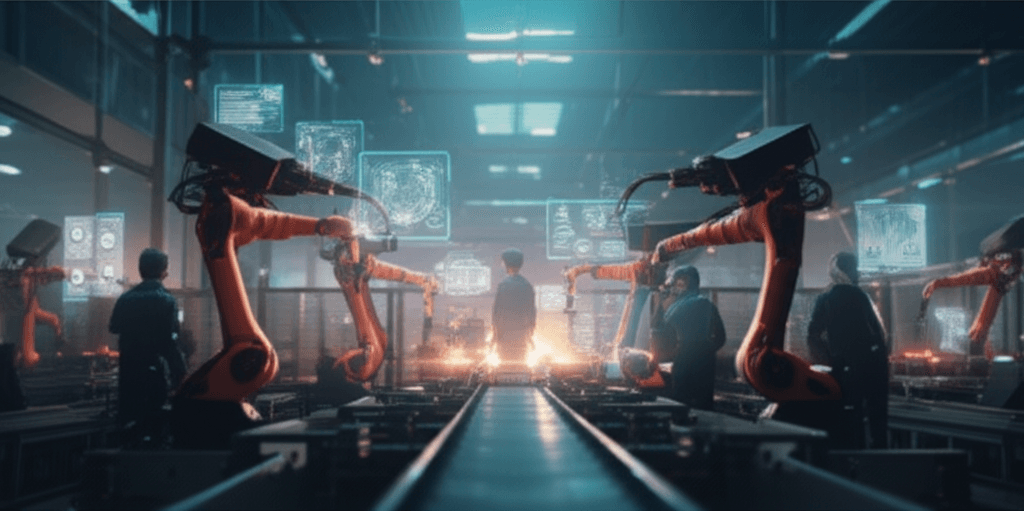
Collaborative robots, or cobots, have become the fastest-growing segment of the industrial robotics market. Unlike their caged predecessors, cobots are designed from the ground up to work alongside human operators, sharing workspace and tasks in ways that were unthinkable just a few years ago.
What Exactly Is a Collaborative Robot?
The International Federation of Robotics defines a collaborative robot as a robot designed to physically interact with humans in a shared workspace. But the reality is more nuanced than that. True collaboration falls on a spectrum.
The Four Modes of Collaboration (ISO 10218-2)
The ISO standards define four collaborative operation modes:
| Mode | Description | Typical Use Case |
|---|---|---|
| Safety-rated monitored stop | Robot stops when human enters workspace | Welding, heavy lifting |
| Hand guiding | Operator physically moves robot | Teaching positions, craft tasks |
| Speed and separation monitoring | Robot slows as human approaches | Palletizing, machine tending |
| Power and force limiting | Robot limits force on contact | Assembly, polishing, inspection |
Most modern cobots operate in the power and force limiting mode, which allows the closest physical collaboration. The key metric is quasi-static force limits defined in ISO/TS 15066, which specifies maximum allowable pressures for each body region.
Force Limits by Body Region
# ISO/TS 15066 maximum quasi-static force limits (Newtons)
FORCE_LIMITS = {
    "skull_forehead": 130,
    "face": 65,
    "neck_sides": 150,
    "back_shoulders": 210,
    "chest": 140,
    "abdomen": 110,
    "upper_arms": 150,
    "forearms": 160,
    "hands_fingers": 140,
    "thighs": 220,
    "knees": 220,
    "lower_legs": 130,
}

def check_safety_compliance(measured_force: float, body_region: str) -> bool:
    """Validate that contact force is within ISO/TS 15066 limits."""
    limit = FORCE_LIMITS.get(body_region)
    if limit is None:
        raise ValueError(f"Unknown body region: {body_region}")
    return measured_force <= limit
The Major Cobot Platforms in 2026
Universal Robots (UR)
Universal Robots pioneered the modern cobot market and remains the market leader. Their lineup spans from the UR3e (3 kg payload) to the UR30 (30 kg payload). The UR ecosystem includes over 400 certified peripherals through the UR+ platform, including grippers, vision systems, and software plugins.
FANUC CRX Series
FANUC brought their decades of industrial robotics expertise to the cobot space with the CRX series. These cobots offer payloads up to 30 kg and are notable for their tablet-based programming interface that lets operators drag and drop waypoints.
ABB GoFa and SWIFTI
ABB offers two cobot families. GoFa targets traditional cobot applications with power and force limiting, while SWIFTI bridges the gap between cobots and industrial robots by using a safety scanner to achieve collaborative operation at higher speeds.
Doosan Robotics
Doosan has emerged as a strong competitor with a full range from 6 to 25 kg payload. Their torque sensors on every joint provide best-in-class sensitivity to unexpected contact.
Key Applications in 2026
Machine Tending
The single most common cobot application. A cobot loads and unloads CNC machines, injection molding machines, or presses. The ROI is compelling because one cobot can tend multiple machines in a cell.
- Cycle time optimization through parallel loading and unloading
- Quality integration with in-process inspection between cycles
- Lights-out operation during off-shifts with buffer trays
Assembly
Cobots excel at repetitive assembly tasks that require consistency but not extreme speed:
- Screw driving with torque verification
- Snap-fit component insertion
- Adhesive dispensing along complex paths
- Wire harness routing
Welding
Cobot welding has taken off, particularly for high-mix, low-volume shops. The combination of hand-guided teaching and adaptive seam tracking makes cobots accessible to shops that cannot justify a traditional welding cell.
# Example: Cobot welding path with adaptive seam tracking
from cobot_sdk import Robot, WeldTorch, SeamTracker

robot = Robot("UR10e")
torch = WeldTorch(wire_feed=8.5, voltage=22.0, gas_flow=15.0)
tracker = SeamTracker(laser_sensor="Servo-Robot IPC-700")

robot.attach_tool(torch)
robot.attach_sensor(tracker)

# Teach initial path by hand guiding
base_path = robot.record_hand_guided_path()

# During execution, tracker adjusts in real-time
for waypoint in base_path:
    offset = tracker.get_seam_offset()
    adjusted = waypoint.translate(offset)
    robot.move_linear(adjusted, speed=0.005)  # 5 mm/s travel speed
    torch.weld()
Quality Inspection
Vision-equipped cobots can inspect parts from multiple angles, reaching into areas that fixed cameras cannot. This is particularly valuable in aerospace and medical device manufacturing where 100% inspection is mandatory.
Implementing Cobots: Lessons from the Field
Risk Assessment Is Non-Negotiable
Before deploying any cobot, you must conduct a thorough risk assessment per ISO 12100. This involves:
- Identifying hazards — what can go wrong?
- Estimating risk — how likely and how severe?
- Reducing risk — engineering controls, then administrative controls
- Validating — testing that residual risk is acceptable
A common mistake is assuming that because a robot is labeled a "cobot," it is inherently safe. The application determines the risk. A cobot holding a sharp deburring tool requires very different safeguards than one placing foam parts in a box.
Total Cost of Ownership
The purchase price of a cobot is typically only 30-40% of the total deployment cost. Budget for:
- End-of-arm tooling — grippers, tool changers, sensors
- Integration — mounting, guarding, programming
- Training — operator and maintenance staff
- Ongoing costs — spare parts, software updates, re-programming for new products
Common Pitfalls
- Overestimating cycle time — cobots are slower than industrial robots by design
- Ignoring ergonomics — the human side of the workstation matters too
- Skipping simulation — offline programming saves weeks of floor time
- Neglecting change management — involve operators early to build trust
The Future: AI-Powered Cobots
The next generation of cobots will incorporate large language models and vision-language models to understand high-level instructions. Instead of programming waypoints, operators will describe tasks in natural language.
Early demonstrations from companies like Covariant, Google DeepMind, and Universal Robots' own research labs show cobots that can:
- Understand spoken instructions like "pack the red widgets in the small box"
- Adapt to unseen objects using zero-shot grasping models
- Learn from demonstration with just one or two human examples
- Reason about failures and request help when uncertain
The cobot market is projected to reach $12 billion by 2030. As AI makes programming easier and sensors make collaboration safer, cobots will become as common in manufacturing as power tools are today.
Getting Started
If you are considering your first cobot deployment, start small. Choose a task that is repetitive, ergonomically challenging for humans, and has a consistent cycle. Machine tending and palletizing are excellent first applications because the pick and place patterns are predictable and the ROI is straightforward to calculate.
The cobot revolution is not about replacing humans. It is about augmenting them, taking over the dull, dirty, and dangerous tasks so that skilled workers can focus on what they do best: thinking, problem-solving, and creating.
Related Posts
The Smart Factory Revolution: How Industrial Automation is Reshaping Manufacturing
Inside the Industry 4.0 transformation: how AI, IoT, cobots, and digital twins are creating the factories of the future. Real case studies from automotive, electronics, and pharmaceutical manufacturing.
Tesla Optimus Gen-3 Begins Limited Production Deployment in Fremont Factory
Tesla has started deploying its third-generation Optimus humanoid robot on the Fremont assembly line, marking the first large-scale use of humanoid robots in automotive manufacturing.