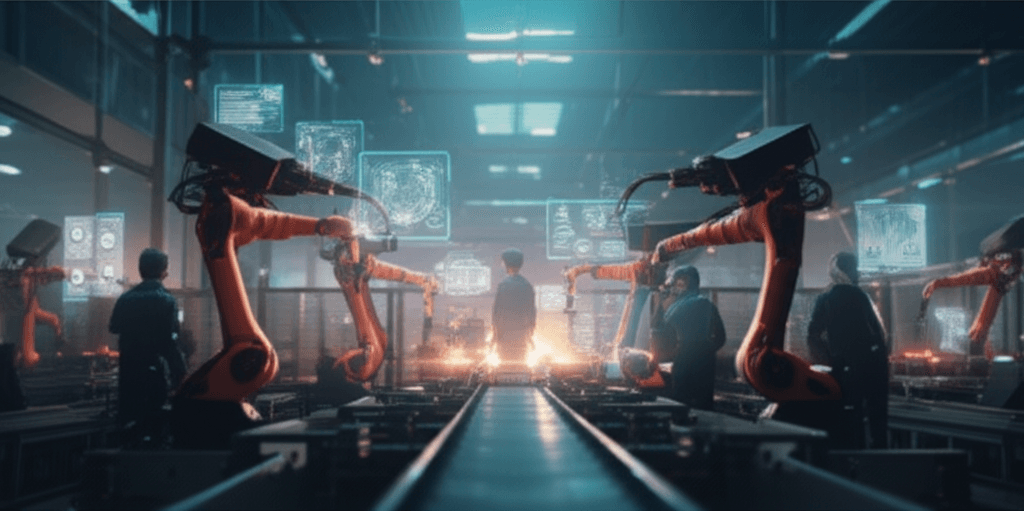
The Smart Factory Revolution: How Industrial Automation is Reshaping Manufacturing
The factory floor of 2026 looks nothing like it did a decade ago. Smart factories — powered by AI, IoT sensors, collaborative robots, and digital twins — are delivering unprecedented levels of efficiency, quality, and flexibility.
What Makes a Factory "Smart"?
A smart factory integrates four key technologies:
1. Industrial IoT (IIoT)
Thousands of sensors monitoring every aspect of production:
- Vibration sensors on motors detect early signs of failure
- Temperature sensors ensure optimal processing conditions
- Vision systems inspect every product for defects
- Energy meters optimize power consumption in real-time
2. Collaborative Robots (Cobots)
Unlike traditional industrial robots locked behind safety cages, cobots work alongside humans:
- Force-limited joints stop immediately on contact
- Hand-guided programming — show the robot what to do
- Quick changeover — reprogram for new tasks in minutes
- Affordable — starting at $25,000, accessible to SMEs
# Example: Programming a cobot palletizing task
from cobot_sdk import Robot, GripperVacuum, PalletPattern

robot = Robot("UR10e")
gripper = GripperVacuum(channels=4)
robot.attach_tool(gripper)

# Define pallet pattern
pattern = PalletPattern(
    rows=4, columns=5, layers=3,
    box_size=(0.3, 0.2, 0.15),  # meters
    pallet_origin=(0.8, 0.0, 0.1)
)

# Execute palletizing cycle
for position in pattern.positions():
    robot.move_to(pickup_station, speed=0.5)
    gripper.activate()
    robot.move_to(position, speed=0.3)
    gripper.release()
3. AI-Powered Quality Control
Machine learning models inspect products faster and more accurately than human inspectors:
- Surface defect detection — scratches, dents, discoloration at 99.7% accuracy
- Dimensional verification — sub-millimeter measurements from camera images
- Anomaly detection — flagging unusual patterns that might indicate process drift
4. Digital Twins
Virtual replicas of the entire factory that mirror real-time operations:
- Simulate production changes before implementing them
- Predict maintenance needs weeks in advance
- Optimize energy usage across the facility
- Train AI models in simulation before deployment
Case Studies
Automotive: BMW's iFactory
BMW's iFactory concept integrates:
- 400+ AI applications across the production line
- Figure 02 humanoid robots for flexible assembly tasks
- Real-time quality control catching 99.9% of defects
- 30% energy reduction through AI-optimized HVAC and lighting
Electronics: Samsung's Smart Factory
Samsung's semiconductor fabs use:
- Predictive maintenance reducing downtime by 50%
- Automated material handling with autonomous vehicles
- AI-optimized process control improving yield by 15%
- Digital twins simulating billion-dollar process changes risk-free
Pharmaceutical: Pfizer's AI-Enabled Production
Pfizer transformed vaccine manufacturing with:
- Continuous manufacturing replacing batch processing
- Real-time quality monitoring ensuring every dose meets specifications
- AI-driven supply chain optimization reducing lead times by 40%
The Economics of Smart Factories
The ROI of smart factory investments is compelling:
| Investment Area | Typical ROI | Payback Period |
|---|---|---|
| Predictive maintenance | 10-25x | 6-12 months |
| AI quality control | 5-15x | 8-18 months |
| Cobot deployment | 3-8x | 12-24 months |
| Digital twin | 4-10x | 18-36 months |
Workforce Transformation
Smart factories don't eliminate jobs — they transform them:
Declining roles:
- Manual assembly line work
- Visual quality inspection
- Routine machine operation
Growing roles:
- Robot programmers and integrators
- Data analysts and AI specialists
- Maintenance technicians for complex systems
- Human-robot collaboration designers
The World Economic Forum estimates that automation will create 97 million new jobs by 2030, while displacing 85 million — a net positive, but requiring significant reskilling.
Building Your Smart Factory: A Roadmap
Phase 1: Foundation (3-6 months)
- Deploy IIoT sensors on critical equipment
- Establish data collection and storage infrastructure
- Implement basic dashboarding and alerting
Phase 2: Intelligence (6-12 months)
- Deploy predictive maintenance models
- Implement AI quality inspection on highest-volume lines
- Create digital twin of key production processes
Phase 3: Automation (12-24 months)
- Deploy cobots for repetitive tasks
- Implement autonomous material handling
- Integrate AI into process control loops
Phase 4: Optimization (24+ months)
- End-to-end production optimization with AI
- Self-configuring production lines
- Fully autonomous quality management
Challenges
- Legacy equipment integration — connecting decades-old machines to modern networks
- Cybersecurity — networked factories face new attack surfaces
- Skills gap — finding workers who can manage AI-powered systems
- Interoperability — ensuring different vendors' systems communicate
- Change management — getting buy-in from the workforce
The Road Ahead
By 2030, analysts predict that 70% of manufacturers will have deployed some form of smart factory technology. The factories that adopt earliest will have compounding advantages in efficiency, quality, and flexibility.
The smart factory revolution isn't coming — it's already here. The only question is how quickly your operation will join it.