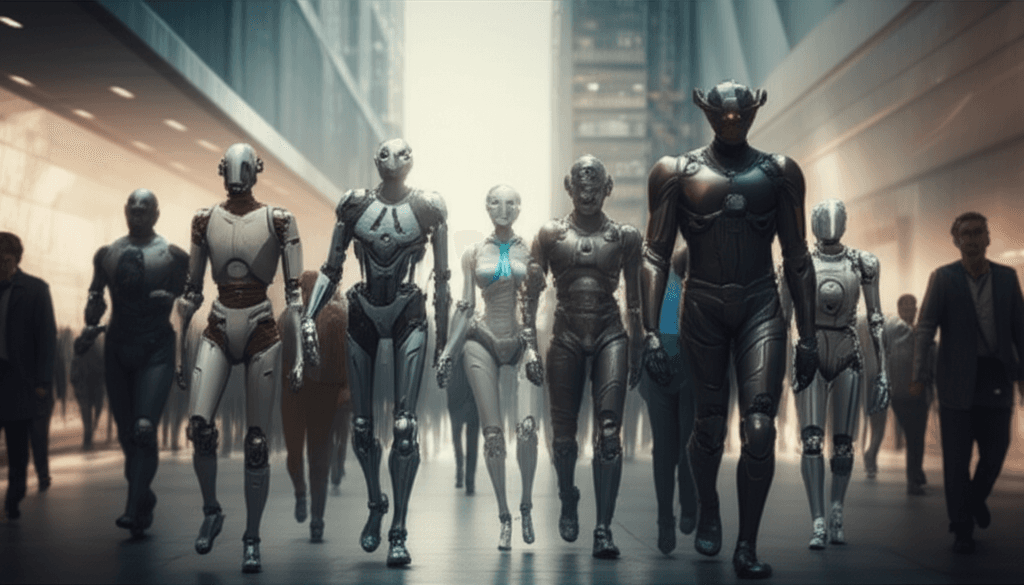
The Future of Humanoid Robots: From Factory Floors to Your Living Room
The humanoid robot revolution is no longer a distant dream. With billions of dollars in investment and breakthroughs in AI, the machines that walk among us are becoming a reality faster than anyone predicted.
The Current Landscape
The humanoid robotics space has exploded in the past two years. Companies that were once considered moonshot ventures are now demonstrating real-world capabilities:
Leading Players
Tesla Optimus has moved beyond prototype stage, with limited deployment in Tesla's own factories. The latest Gen 3 model can handle delicate assembly tasks and navigate dynamic environments.
Figure AI raised over $2 billion and their Figure 02 robot is being tested in BMW manufacturing facilities. Their approach combines purpose-built hardware with cutting-edge AI.
Boston Dynamics Atlas remains the benchmark for physical capability. Their electric Atlas platform, unveiled in 2024, represents a complete reimagining of their hydraulic predecessor.
1X Technologies is taking a different approach with their NEO humanoid, focusing on affordability and home use cases rather than industrial applications.
The AI Breakthrough
What changed? In a word: AI. The convergence of several technologies has made humanoid robots practical:
- Foundation models provide general-purpose reasoning
- Vision-language models enable robots to understand their environment
- Reinforcement learning allows robots to learn complex physical tasks
- Sim-to-real transfer dramatically reduces training time
# Simplified example of a modern robot learning pipeline
class RobotLearningPipeline:
    def __init__(self):
        self.foundation_model = load_vlm("gpt-4-robotics")
        self.policy_network = PolicyNet(obs_dim=256, act_dim=32)
        self.sim_env = IsaacGym("humanoid_manipulation")

    def train(self, task_description: str):
        # LLM decomposes high-level task into subtasks
        subtasks = self.foundation_model.plan(task_description)

        # Each subtask trained in simulation
        for subtask in subtasks:
            reward_fn = self.foundation_model.generate_reward(subtask)
            self.policy_network.train(self.sim_env, reward_fn)
Challenges Ahead
Despite the progress, significant challenges remain:
- Battery life — Current humanoids operate for 2-4 hours max
- Dexterous manipulation — Human-level hand dexterity is still years away
- Cost — Most humanoids cost $50,000-$150,000, far from consumer pricing
- Safety — Sharing space with powerful machines requires robust safety systems
- Regulation — Legal frameworks for autonomous robots are still being developed
The Road to Your Living Room
Industry experts project a phased rollout:
| Timeframe | Use Case | Price Range |
|---|---|---|
| 2026-2027 | Factory & warehouse | $80,000-$150,000 |
| 2028-2029 | Commercial & healthcare | $40,000-$80,000 |
| 2030-2032 | Home assistance | $15,000-$30,000 |
The consensus is that humanoid robots will first prove their value in industrial settings, where the ROI is clearest, before trickling down to consumer applications.
Conclusion
We're at an inflection point in robotics. The combination of advanced AI, improving hardware, and massive investment means humanoid robots will become an increasingly common sight over the next decade. The question is no longer if but when — and the answer is sooner than most people think.
Related Posts
OpenAI Partners with Leading Robotics Firms to Bring GPT Models to Physical Robots
OpenAI has announced strategic partnerships with Boston Dynamics, Agility Robotics, and Figure AI to integrate its latest GPT models into humanoid and quadruped robots.
Understanding Transformer Architecture: The Engine Powering Modern Robotics AI
A comprehensive guide to how transformer neural networks — originally designed for language — are revolutionizing robot perception, planning, and control in 2026.
Tesla Optimus Gen-3 Begins Limited Production Deployment in Fremont Factory
Tesla has started deploying its third-generation Optimus humanoid robot on the Fremont assembly line, marking the first large-scale use of humanoid robots in automotive manufacturing.
AI-Powered Surgical Robots: How Artificial Intelligence is Revolutionizing Modern Medicine
Explore how AI-driven surgical robots are transforming healthcare with unprecedented precision, shorter recovery times, and better patient outcomes. From the da Vinci system to fully autonomous procedures.