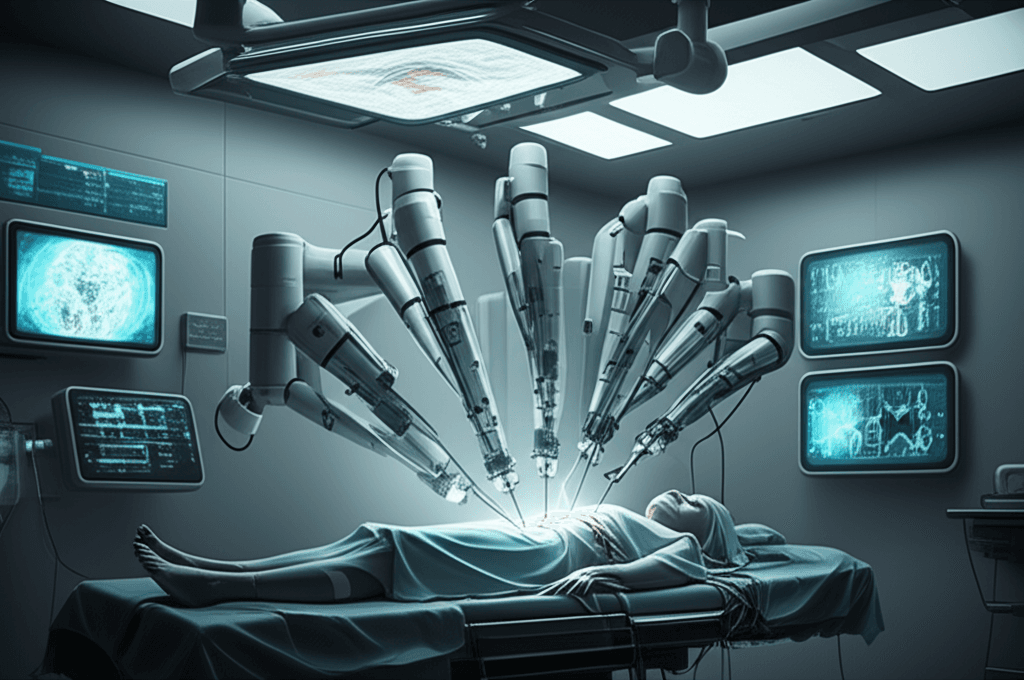
AI-Powered Surgical Robots: How Artificial Intelligence is Revolutionizing Modern Medicine
Surgical robotics has entered a new era. Powered by artificial intelligence, the latest generation of surgical robots can perform procedures with a precision that surpasses even the steadiest human hands — and they're getting smarter every day.
The Evolution of Surgical Robotics
The journey from early laparoscopic tools to today's AI-powered surgical systems represents one of the most remarkable technological progressions in modern medicine.
First Generation: Teleoperated Systems
The da Vinci Surgical System, introduced by Intuitive Surgical in 2000, pioneered the field. These systems don't operate autonomously — they translate a surgeon's hand movements into precise micro-movements of robotic instruments inside the patient's body.
Key advantages of teleoperated systems:
- Tremor filtration — eliminates natural hand tremors
- Motion scaling — large hand movements become tiny, precise instrument movements
- Enhanced visualization — 3D high-definition cameras provide superior views
- Ergonomic benefits — surgeons operate from a comfortable console
Second Generation: AI-Assisted Surgery
The current generation integrates AI to augment the surgeon's capabilities:
# Simplified AI-assisted surgical planning pipeline
class SurgicalAIPipeline:
    def __init__(self):
        self.segmentation_model = load_model("organ_segmentation_v3")
        self.path_planner = RobotPathPlanner(dof=7)
        self.risk_analyzer = RiskAssessmentModel()

    def preoperative_plan(self, ct_scan, mri_scan):
        # 3D reconstruction from imaging
        anatomy = self.segmentation_model.segment(ct_scan, mri_scan)

        # Identify critical structures to avoid
        risk_zones = self.risk_analyzer.identify_risks(anatomy)

        # Generate optimal surgical path
        plan = self.path_planner.optimize(
            target=anatomy.tumor,
            avoid=risk_zones,
            constraints={"max_force": 2.0, "precision": 0.1}  # mm
        )
        return plan
Third Generation: Semi-Autonomous Procedures
The frontier of surgical robotics is semi-autonomous operation. In 2025, the Smart Tissue Autonomous Robot (STAR) demonstrated the ability to perform laparoscopic surgery on soft tissue without human guidance — a landmark achievement.
Key Players in Surgical Robotics
| Company | System | Specialty | AI Integration |
|---|---|---|---|
| Intuitive Surgical | da Vinci 5 | Multi-specialty | Computer vision, force feedback |
| Medtronic | Hugo RAS | General surgery | Cloud-based AI analytics |
| Johnson & Johnson | Ottava | Soft tissue | Real-time tissue classification |
| CMR Surgical | Versius | Minimal access | Machine learning optimization |
| Vicarious Surgical | VS System | Abdominal | VR + AI guidance |
How AI is Making Surgery Safer
Real-Time Tissue Recognition
Modern surgical AI can identify tissue types in real-time using computer vision. This helps surgeons distinguish between healthy tissue, tumors, nerves, and blood vessels — reducing the risk of accidental damage to critical structures.
Predictive Analytics
AI systems analyze thousands of previous surgeries to predict potential complications before they occur:
- Bleeding risk assessment — identifying high-risk areas before incision
- Optimal instrument selection — recommending the best tool for each step
- Recovery time prediction — personalized estimates based on patient data
Autonomous Suturing
One of the most promising developments is autonomous suturing. AI-controlled robots can now place sutures with consistent tension and spacing that matches or exceeds expert surgeons:
# Autonomous suturing control loop
def autonomous_suture(robot, tissue_edge, suture_params):
    """Execute a single suture with AI-controlled precision."""
    # Detect optimal entry/exit points using computer vision
    entry_point = robot.vision.detect_suture_point(
        tissue_edge, margin=suture_params.bite_depth
    )

    # Plan needle trajectory considering tissue elasticity
    trajectory = robot.planner.compute_arc(
        entry=entry_point,
        exit=entry_point.mirror(),
        needle_radius=suture_params.needle_curvature,
        tissue_model=robot.tissue_analyzer.get_properties()
    )

    # Execute with force feedback monitoring
    robot.execute_trajectory(
        trajectory,
        max_force=suture_params.max_force,
        abort_on_anomaly=True
    )
The Numbers Tell the Story
The impact of AI-assisted surgical robotics is measurable:
- 38% reduction in surgical complications (Journal of Surgical Research, 2025)
- 25% shorter hospital stays compared to traditional surgery
- 50% less blood loss in AI-guided procedures
- 3x faster recovery for minimally invasive robotic procedures
Challenges and Ethical Considerations
Technical Challenges
- Latency — AI processing must be near-instantaneous for safety
- Generalization — Systems trained on one anatomy may struggle with anatomical variations
- Haptic feedback — Replicating the "feel" of tissue through robotic instruments
- Connectivity — Remote surgery requires ultra-low-latency networks (5G/6G)
Ethical Questions
- Who is liable when an autonomous surgical robot makes an error?
- How do we ensure equitable access to AI-powered surgery?
- What level of autonomy should surgical robots have?
- How do we maintain surgeon skills as AI takes over more tasks?
What's Coming Next
The next five years will see dramatic advances:
2026-2027: AI co-pilots become standard in major surgical systems, providing real-time guidance and warning systems.
2028-2029: Semi-autonomous procedures for routine operations like appendectomies and cholecystectomies receive regulatory approval.
2030+: Micro-surgical robots small enough to navigate blood vessels, powered by AI, could revolutionize treatment for stroke, aneurysms, and cancer.
Conclusion
AI-powered surgical robots represent one of the most impactful applications of robotics technology. As AI systems become more sophisticated and regulatory frameworks catch up, we're moving toward a future where the precision and consistency of robotic surgery is available to every patient, everywhere. The operating room of tomorrow will be a collaboration between human expertise and machine intelligence — and patients will be the ultimate beneficiaries.
Related Posts
OpenAI Partners with Leading Robotics Firms to Bring GPT Models to Physical Robots
OpenAI has announced strategic partnerships with Boston Dynamics, Agility Robotics, and Figure AI to integrate its latest GPT models into humanoid and quadruped robots.
Tesla Optimus Gen-3 Begins Limited Production Deployment in Fremont Factory
Tesla has started deploying its third-generation Optimus humanoid robot on the Fremont assembly line, marking the first large-scale use of humanoid robots in automotive manufacturing.
Embodied AI Foundation Models: Teaching Robots to Understand the Physical World
How foundation models like RT-2, Octo, and pi-zero are enabling robots to generalize across tasks, environments, and even robot bodies — ushering in the era of general-purpose robotic intelligence.
The Future of Humanoid Robots: From Factory Floors to Your Living Room
An in-depth look at the current state of humanoid robotics, the key players driving innovation, and what the next decade holds for human-shaped machines.