Machine Learning for Autonomous Navigation: From Self-Driving Cars to Delivery Drones
Autonomous navigation is one of the most challenging problems in robotics. A robot must perceive its environment, understand where it is, plan a safe path, and execute that plan — all in real-time. Machine learning has transformed every step of this pipeline.
The Navigation Stack
Modern autonomous navigation systems typically consist of four layers:
- Perception — sensing the environment (cameras, LiDAR, radar)
- Localization — determining the robot's position
- Planning — computing a path from A to B
- Control — executing the planned path
Traditional vs. ML-Based Approaches
The traditional approach uses hand-crafted algorithms at each layer. The ML approach increasingly replaces or augments these with learned models:
| Layer | Traditional | ML-Based |
|---|---|---|
| Perception | Point cloud filtering | 3D object detection networks |
| Localization | Extended Kalman Filter | Neural SLAM |
| Planning | A*, RRT* | Learned cost maps |
| Control | PID controllers | Reinforcement learning policies |
SLAM: Simultaneous Localization and Mapping
SLAM is the foundational problem: building a map of an unknown environment while simultaneously tracking the robot's location within it.
Visual SLAM with Deep Learning
Modern Visual SLAM systems use neural networks for feature extraction and matching:
class DeepVisualSLAM:
    """Neural network-enhanced Visual SLAM system."""

    def __init__(self):
        self.feature_extractor = SuperPoint()  # Learned keypoints
        self.matcher = LightGlue()  # Learned matching
        self.depth_estimator = DepthAnythingV2()
        self.pose_graph = PoseGraph()
        self.map = VoxelMap(resolution=0.05)

    def process_frame(self, rgb_image):
        # Extract learned features
        keypoints, descriptors = self.feature_extractor(rgb_image)

        # Estimate depth from monocular image
        depth = self.depth_estimator(rgb_image)

        # Match with previous frame
        if self.prev_frame:
            matches = self.matcher(
                self.prev_descriptors, descriptors
            )
            # Estimate relative pose from matches + depth
            pose = self.estimate_pose(matches, depth)
            self.pose_graph.add_edge(pose)

        # Update 3D map
        points_3d = self.backproject(keypoints, depth)
        self.map.integrate(points_3d, self.current_pose)

        self.prev_frame = rgb_image
        self.prev_descriptors = descriptors
LiDAR SLAM
For outdoor navigation, LiDAR-based SLAM remains the gold standard. Modern systems like KISS-ICP and CT-ICP achieve centimeter-level accuracy using efficient point cloud registration.
Path Planning with Learned Cost Maps
Traditional path planners like A* and RRT* work well with static maps, but struggle with:
- Dynamic obstacles (pedestrians, other vehicles)
- Terrain assessment (mud, gravel, slopes)
- Social navigation (respecting personal space, following traffic norms)
Machine learning addresses these by learning cost maps from experience:
class LearnedCostMap:
    """Neural network that predicts traversability costs."""

    def __init__(self):
        self.terrain_classifier = TerrainNet()
        self.dynamic_predictor = TrajectoryPredictor()

    def compute_cost(self, position, lidar_scan, camera_image):
        # Terrain traversability from visual + geometric features
        terrain_cost = self.terrain_classifier(
            camera_image, lidar_scan
        )

        # Predicted future positions of dynamic obstacles
        dynamic_obstacles = self.dynamic_predictor(
            lidar_scan, time_horizon=5.0
        )

        # Combined cost map
        total_cost = terrain_cost + self.inflation_cost(dynamic_obstacles)
        return total_cost
End-to-End Navigation
The most exciting recent development is end-to-end navigation — a single neural network that takes sensor input and directly outputs control commands, bypassing the traditional modular pipeline.
Key Approaches
Imitation Learning: Train on expert demonstrations
- The robot learns by watching humans navigate
- Works well for structured environments (roads, warehouses)
- Struggles with rare scenarios not in the training data
Reinforcement Learning: Learn through trial and error
- The robot explores and receives rewards for reaching goals
- Handles novel situations better than imitation learning
- Training in simulation with sim-to-real transfer
Vision-Language Navigation: Follow natural language instructions
- "Go to the kitchen and pick up the red mug"
- Combines navigation with language understanding
- Critical for home and service robots
Real-World Applications
Self-Driving Vehicles
Companies like Waymo, Cruise, and Tesla are deploying ML-powered navigation at scale:
- Waymo uses a combination of LiDAR, cameras, and radar with transformer-based perception
- Tesla relies on camera-only perception with a massive neural network
- Cruise (GM) focuses on dense urban environments
Delivery Robots
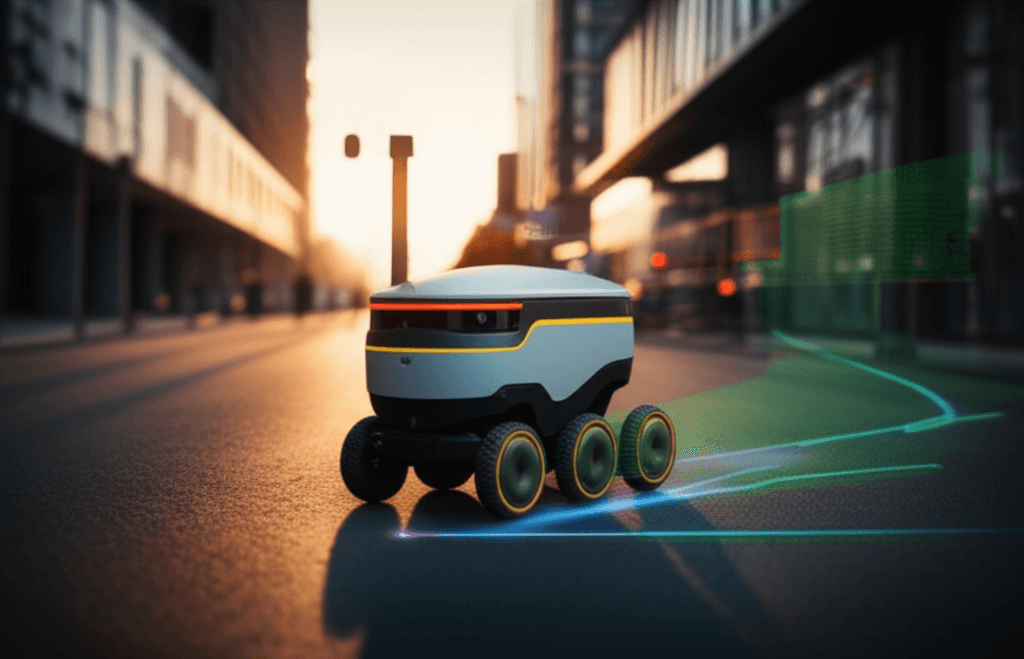
Sidewalk delivery robots from Starship Technologies and Serve Robotics navigate pedestrian environments:
- Sidewalk detection and curb recognition
- Pedestrian prediction and social-aware navigation
- Weather adaptation (rain, snow, darkness)
Agricultural Robots
Autonomous tractors and harvesters use ML for:
- Row following in crop fields
- Obstacle detection (animals, irrigation equipment)
- Terrain assessment for variable ground conditions
Warehouse Robots
Amazon's fleet of 750,000+ warehouse robots uses ML for:
- Multi-robot coordination and traffic management
- Dynamic path replanning around human workers
- Efficient shelf retrieval optimization
Challenges Remaining
- Long-tail scenarios — rare events that ML models haven't seen enough of
- Weather robustness — performance degrades in rain, fog, snow, and darkness
- Interpretability — understanding why a navigation system made a specific decision
- Certification — proving safety for regulatory approval
- Map maintenance — keeping representations current as environments change
The Future of Autonomous Navigation
The field is converging on foundation models for navigation — large pre-trained models that can be fine-tuned for specific robots and environments. Combined with better simulation and more efficient sim-to-real transfer, we're approaching a future where any robot can navigate any environment with minimal setup.
The next generation of navigation systems won't just follow paths — they'll understand spaces the way humans do, making robots truly capable of operating in the unpredictable real world.
Related Posts
Interview: Building Robots for Mars with NASA JPL Engineer Dr. Sarah Chen
NASA JPL robotics engineer Dr. Sarah Chen talks about Mars rover design, autonomous navigation on other planets, and the future of space robotics missions.
Reinforcement Learning for Robot Control: A Deep Dive into Training Robots Through Trial and Error
How reinforcement learning enables robots to learn complex physical tasks — from walking and grasping to playing table tennis. Covers sim-to-real transfer, reward shaping, and the latest RL algorithms for robotics.