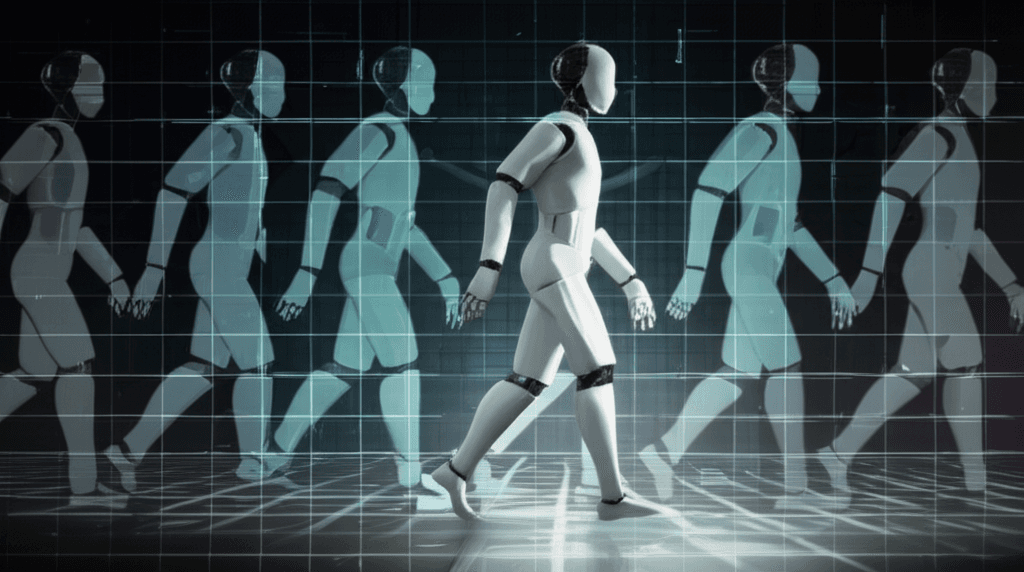
Reinforcement Learning for Robot Control: A Deep Dive into Training Robots Through Trial and Error
Reinforcement learning (RL) has become one of the most powerful tools for teaching robots to perform complex physical tasks. Rather than programming every motion by hand, RL lets robots learn through trial and error — millions of attempts in simulation, refined to work in the real world.
What is Reinforcement Learning?
At its core, RL is simple: an agent takes actions in an environment, receives rewards, and learns a policy that maximizes cumulative reward over time.
For robotics:
- Agent = the robot's control system
- Actions = motor commands (joint torques, velocities)
- Environment = the physical world (or a simulation of it)
- Reward = a signal indicating task success (distance to goal, task completion, energy efficiency)
# Core RL training loop for robotics
def train_robot_policy(env, policy, num_episodes=1_000_000):
    optimizer = torch.optim.Adam(policy.parameters(), lr=3e-4)
    replay_buffer = ReplayBuffer(capacity=1_000_000)

    for episode in range(num_episodes):
        state = env.reset()
        episode_reward = 0

        while not env.done:
            # Policy selects action
            action = policy.sample_action(state)

            # Environment responds
            next_state, reward, done, info = env.step(action)

            # Store experience
            replay_buffer.add(state, action, reward, next_state, done)

            # Update policy from batch of experiences
            if len(replay_buffer) > 1000:
                batch = replay_buffer.sample(256)
                loss = policy.update(batch)

            state = next_state
            episode_reward += reward

        if episode % 1000 == 0:
            print(f"Episode {episode}: reward = {episode_reward:.2f}")
The Sim-to-Real Pipeline
The biggest challenge in RL for robotics is the sim-to-real gap: policies trained in simulation often fail when transferred to real hardware. Modern approaches bridge this gap with several techniques:
Domain Randomization
Randomly vary simulation parameters during training so the policy becomes robust to real-world variation:
- Visual randomization — textures, lighting, camera angles
- Physical randomization — mass, friction, joint stiffness
- Noise injection — sensor noise, communication delays
class DomainRandomizer:
    """Randomize simulation parameters for robust sim-to-real transfer."""

    def randomize(self, env):
        # Randomize physics
        env.set_gravity(9.81 + np.random.uniform(-0.5, 0.5))
        env.set_friction(np.random.uniform(0.5, 1.5))

        for joint in env.robot.joints:
            joint.damping *= np.random.uniform(0.8, 1.2)
            joint.stiffness *= np.random.uniform(0.8, 1.2)

        # Randomize observations
        env.observation_noise = np.random.uniform(0.0, 0.05)
        env.action_delay = np.random.randint(0, 3)  # frames

        # Randomize visuals
        env.set_lighting(
            direction=np.random.randn(3),
            intensity=np.random.uniform(0.5, 2.0)
        )
System Identification
Instead of randomizing everything, carefully measure real-world parameters and match them in simulation:
- Measure joint friction with torque sensors
- Characterize motor response curves
- Calibrate camera intrinsics and latency
Sim-to-Real Adaptation
Fine-tune the simulation-trained policy with a small amount of real-world data:
- Residual policies — learn a correction on top of the sim-trained policy
- Online adaptation — continuously adjust policy parameters based on real feedback
- Meta-learning — train the policy to adapt quickly to new dynamics
Landmark Achievements
Locomotion
| Achievement | Organization | Year | Details |
|---|---|---|---|
| Agile quadruped locomotion | ETH Zurich | 2022 | ANYmal navigating rough terrain |
| Humanoid walking from scratch | UC Berkeley | 2024 | Digit learning to walk via RL |
| Parkour with quadruped | MIT | 2024 | Mini Cheetah doing backflips |
| Humanoid soccer | DeepMind | 2025 | Full 5v5 robot soccer |
| Bipedal running at 10 km/h | Agility | 2026 | Digit Gen 3 outdoor running |
Manipulation
- Dexterous in-hand manipulation — OpenAI's work on Rubik's cube solving transferred to robotic hands
- Tool use — robots learning to use hammers, screwdrivers, and spatulas through RL
- Deformable object manipulation — folding clothing, handling cables
Combined Locomotion + Manipulation
The holy grail: robots that can walk, navigate, and manipulate objects simultaneously. Recent work from Humanoid-Gym and Isaac Lab shows bipedal robots learning to carry objects while navigating obstacles.
Modern RL Algorithms for Robotics
PPO (Proximal Policy Optimization)
The workhorse of robotics RL. Stable, reliable, and parallelizable:
- Used by most locomotion research
- Scales to thousands of parallel environments
- Good balance of sample efficiency and stability
SAC (Soft Actor-Critic)
Better for tasks requiring exploration and fine-grained control:
- Entropy regularization encourages exploration
- Works well for manipulation tasks
- More sample-efficient than PPO for some problems
Diffusion Policy
The newest approach — model the action distribution as a diffusion process:
- Handles multi-modal action distributions
- Excellent for complex manipulation
- Can be combined with imitation learning
Reward Engineering
The hardest part of RL for robotics is often designing the reward function. Get it wrong, and the robot finds clever shortcuts that technically maximize reward but don't accomplish the task.
Common Reward Components
def locomotion_reward(state, action, next_state):
    # Forward velocity reward
    velocity_reward = next_state.forward_velocity * 1.0

    # Energy penalty (encourage efficiency)
    energy_penalty = -0.001 * np.sum(action ** 2)

    # Stability reward (keep torso upright)
    orientation_reward = -0.5 * np.abs(next_state.torso_pitch)

    # Smoothness penalty (avoid jerky motion)
    smoothness_penalty = -0.01 * np.sum(
        (action - state.prev_action) ** 2
    )

    # Survival bonus (don't fall)
    alive_bonus = 1.0 if next_state.height > 0.3 else 0.0

    return (velocity_reward + energy_penalty +
            orientation_reward + smoothness_penalty + alive_bonus)
LLM-Generated Rewards
A fascinating recent trend: using large language models to generate reward functions from natural language task descriptions. This dramatically reduces the engineering effort required to specify new tasks.
Training Infrastructure
Modern robotics RL requires massive parallel simulation:
- NVIDIA Isaac Lab — GPU-accelerated physics simulation, 10,000+ environments in parallel
- MuJoCo — fast, accurate physics for manipulation and locomotion
- PyBullet — open-source alternative with good robot models
- Genesis — newest entry with differentiable physics
A typical training run:
- 4,096 parallel environments on a single GPU
- 500 million timesteps over 4-8 hours
- Policy evaluated every 1M steps on held-out scenarios
- Best checkpoint deployed to real hardware
Practical Tips for Getting Started
- Start in simulation — always train in sim first, real-world experiments are expensive
- Use Isaac Lab or MuJoCo — don't build your own physics engine
- Start with PPO — it's the most forgiving algorithm
- Curriculum learning — start with easy tasks and gradually increase difficulty
- Reward shaping matters — spend time designing good rewards
- Log everything — use Weights & Biases or TensorBoard to track experiments
- Domain randomization — it's essential for sim-to-real transfer
The Future
Reinforcement learning for robotics is converging with foundation models. The next generation of RL systems will combine:
- Pre-trained visual representations for better perception
- Language-conditioned policies for task specification
- World models for more sample-efficient learning
- Multi-task training for general-purpose robot skills
The dream of robots that learn from experience, adapt to new situations, and continuously improve is becoming reality — one training run at a time.
Related Posts
Sim-to-Real Transfer: Bridging the Gap Between Virtual Training and Physical Robots
The complete guide to sim-to-real transfer for robotics — how to train robot policies in simulation and deploy them on real hardware. Covers domain randomization, system identification, and the latest gap-closing techniques.
NVIDIA Launches Isaac Robotics Platform 2.0 with Revolutionary Sim-to-Real Transfer
NVIDIA's Isaac Platform 2.0 introduces photorealistic simulation, one-click sim-to-real deployment, and a new foundation model for robot manipulation — dramatically lowering the barrier to building intelligent robots.
Machine Learning for Autonomous Navigation: From Self-Driving Cars to Delivery Drones
How machine learning algorithms enable robots and vehicles to navigate complex environments autonomously. Covers SLAM, path planning, obstacle avoidance, and the latest advances in end-to-end navigation.